

Where Can Shoppers Find Used Trucks and SUVs Near Winchester, VA?
Shoppers searching for pre-owned trucks and SUVs near Winchester can find an extensive regional selection along the Interstate 81 corridor at Hamilton Nissan, situated approximately 42 miles north in Hagerstown. Taking Interstate 81 North provides a direct 45-minute drive from the northern Shenandoah Valley straight to Dual Highway, giving regional buyers direct access to thoroughly inspected pickups, mid-size utility vehicles, and three-row family crossovers.
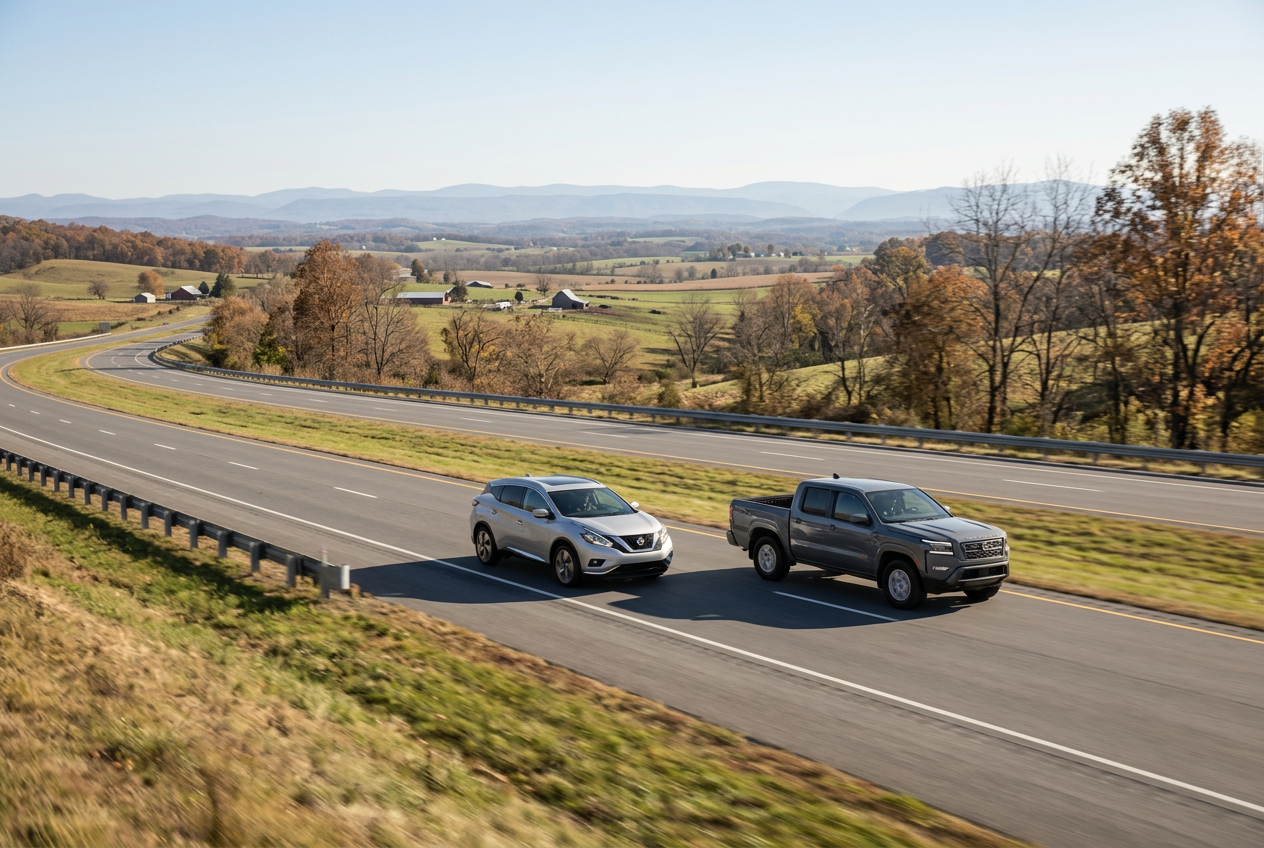
Navigating vehicle availability across state lines often provides a broader inventory selection than staying within a single municipal market. Drivers visiting from the historic Old Town area of Winchester frequently make the short drive up the corridor to compare diverse configurations side by side. Exploring trucks across different bed lengths, drivetrains, and passenger capacities in one central location allows buyers to verify cabin comfort and utility firsthand before making a final buying decision.
Our dealership assists regional cross-border buyers by handling all necessary registration paperwork directly. When a Virginia resident purchases a pre-owned truck or crossover in Maryland, our business office calculates the appropriate Virginia sales and use tax, processes title documentation, and coordinates registration with the Virginia Department of Motor Vehicles. To review travel routes from your neighborhood, consult our Hagerstown showroom directions before heading north.
If you want to verify that a specific truck cab configuration or all-wheel-drive SUV is parked on the lot before you travel, give our staff a quick call to check today's availability.
Table of Contents
- What Is the Minimum Recommended Ground Clearance for Unpaved Mountain Roads?
- How Does Cab Size Affect Rear Passenger Room in Used Pickups?
- Does a Clean Vehicle History Report Guarantee a Truck Was Never in an Accident?
- What Additional Warranty Benefits Come with a Certified Pre-Owned Vehicle?
- Common Questions About Buying Used Trucks and SUVs
- Finding and Financing Your Pre-Owned Truck or SUV at Hamilton Nissan
What Is the Minimum Recommended Ground Clearance for Unpaved Mountain Roads?
The minimum recommended ground clearance for unpaved mountain roads is 8 inches, which provides essential underbody margin to clear embedded rock shelves, rain-carved washouts, and crown ruts without striking critical mechanical hardware. Vehicles operating with less than 8 inches risk scraping exhaust hangers, transmission oil pans, or low-hanging differential housings against high centers or displaced stones.
Maintaining adequate clearance protects sensitive running gear across rough terrain:
- Underbody protection: Clearance above 8 inches keeps the oil pan, transfer case, and fuel tank above standard track debris.
- Approach angle clearance: Steeper entry angles prevent the front bumper fascia from bottoming out at the base of sharp ascents.
- Breakover clearance: Generous space between the front and rear axles keeps the rocker panels from high-centering over ridge crests.
- Departure angle buffer: Taller rear ride height ensures the hitch receiver and spare tire carrier do not drag when exiting water diversions.
For drivers frequenting backcountry trailheads, forestry access roads, or unpaved elevation climbs, purpose-built platforms provide the necessary protection. The Nissan Frontier in its PRO-4X trim utilizes dedicated underbody skid plates and an off-road suspension that delivers confident trail clearance alongside an EPA-estimated 18 mpg combined rating for its 4x4 configuration. Mid-size crossover platforms like the Nissan Pathfinder feature an available intelligent 4x4 system paired with multi-terrain drive modes, accommodating moderate forest trails and winter weather while retaining an EPA rating of 21 mpg city / 27 hwy in standard front-drive trim.
Proper vehicle maintenance is equally critical when traveling over uneven mountain terrain. Shock absorbers, ball joints, and tire tread wear must remain in sound mechanical order to maintain factory ride height. Drivers preparing an existing vehicle for mountain travel can easily schedule an inspection or maintenance appointment with our factory-trained service technicians to confirm suspension health and undercarriage integrity.
How Does Cab Size Affect Rear Passenger Room in Used Pickups?
Cab size directly dictates rear passenger room, with full crew cabs delivering between 39 inches and 44 inches of rear legroom compared to just 28 inches to 33 inches in extended cabs. That 10-inch differential determines whether the second row functions as a comfortable seating area for adults and rear-facing car seats or serves primarily as weather-protected secondary cargo storage.
Evaluating cab configurations involves balancing cabin volume against cargo bed utility:
- Regular Cab: Two doors with a single front bench or bucket pair; provides zero second-row passenger capacity but maximizes cargo box length.
- Extended Cab: Marketed as King Cab, SuperCab, or Access Cab; features compact rear jump seats or an upright bench with limited leg space, suited best for emergency passenger trips or tools.
- Crew Cab: Marketed as Crew Cab, SuperCrew, or CrewMax; features four full-size, forward-hinged doors and deep second-row seating that accommodates growing families and work crews on long commutes.
On used mid-size pickups such as the Nissan Frontier, cab configuration also influences mechanical capacity. A Frontier King Cab in two-wheel drive delivers a maximum towing rating of up to 7,150 pounds and a maximum payload rating of 1,590 pounds, driven by a 310-hp 3.8-liter V6 engine. Choosing a heavier four-door crew cab body style slightly adjusts those maximum limits, demonstrating why reviewing the specific door-jamb weight certification label is essential for buyers planning to haul heavy recreational gear.
For active households living near the outdoor recreation corridors surrounding Winchester, choosing between an extended cab and a crew cab comes down to daily passenger routines. To evaluate passenger space across various body styles and configurations, browse our current pre-owned truck and SUV selection to inspect interior dimensions. Shoppers who find they prioritize passenger comfort and enclosed luggage space over open cargo beds can also compare our available used sedan options, or start the transition process by evaluating your trade-in to apply current vehicle equity toward a larger pickup cabin.
Does a Clean Vehicle History Report Guarantee a Truck Was Never in an Accident?
A clean vehicle history report does not guarantee that a pre-owned truck has never suffered collision damage, because history databases only document events reported by insurance carriers, police departments, or participating repair shops. Private cash repairs, off-road trail scrapes repaired without insurance claims, or recent incidents that have not yet cleared administrative reporting pipelines will not appear on a vehicle report.
A vehicle history report serves as an informative historical baseline rather than an exhaustive mechanical certification. Thorough used-vehicle shoppers always combine digital records with a rigorous physical inspection:
- Frame and rail alignment: Examine the truck's boxed frame rails for ripple marks, fresh black spray paint, or mismatched welds that indicate prior pulling.
- Panel gaps and fasteners: Check that the spacing between fenders, doors, and the truck bed is even, and confirm under-hood fender bolts retain factory paint without tool scoring.
- Paint consistency: Look for orange-peel texture differences or overspray along door seals, window trim, and cab corners.
- Independent mechanical review: Hire a third-party ASE-certified technician to place the vehicle on a hydraulic lift to examine axle alignment, steering linkage, and floor-pan condition.
Independent pre-purchase vehicle inspections typically cost between $120 and $250, providing an unbiased assessment of unseen mechanical wear, hidden rust, or prior collision repairs. When reviewing any used truck, request available documentation from our team so we can walk through previous ownership records, service stamps, and inspection findings together.
Shoppers seeking complete certainty regarding factory assembly and zero previous accident history often prefer exploring our new Nissan inventory to secure a factory-fresh vehicle backed by full original manufacturer warranties. For buyers balancing peace of mind with disciplined spending, our team can also introduce practical options from our new vehicles under $30,000 inventory.
What Additional Warranty Benefits Come with a Certified Pre-Owned Vehicle?
A certified pre-owned vehicle includes extended factory-backed limited warranty coverage, a thorough multi-point mechanical inspection, and manufacturer-supported emergency assistance that standard used vehicles do not provide. These manufacturer-backed programs bridge the gap between traditional used vehicles and new models by establishing strict age, mileage, and mechanical benchmarks before certification is granted.
Every certified pre-owned Nissan must pass an intensive multi-point inspection conducted by factory-trained technicians, resolving or replacing worn components with genuine Nissan parts. Key benefits typically integrated into the certified ownership structure include:
- Powertrain coverage: Up to a 7-year/100,000-mile limited warranty measured from the original new-vehicle in-service date, protecting the engine, transmission, and drivetrain assembly.
- Roadside support: Round-the-clock emergency assistance covering flat-tire changes, battery jump-starts, fuel delivery, and lockout assistance.
- Towing benefits: Direct dispatch to an authorized Nissan service facility if mechanical failure occurs while traveling.
- Trip interruption protection: Reimbursement provisions for meals and lodging if a covered mechanical breakdown occurs far from home.
When unexpected road hazards arise during regional family travel or seasonal road trips toward community events like the Shenandoah Apple Blossom Festival, having direct manufacturer backing provides reliable support. Nissan owners have exclusive access to dedicated assistance by calling Nissan Roadside Assistance: 1-800-225-2476, ensuring direct coordination with authorized repair facilities and certified master technicians.
To explore late-model crossovers and pickups that meet these rigorous mechanical criteria, review our online certified pre-owned Nissan inventory to compare inspected vehicles that include extended warranty documentation.
Common Questions About Buying Used Trucks and SUVs
Q: How much does an independent pre-purchase vehicle inspection cost?
An independent pre-purchase inspection performed by an ASE-certified technician or dedicated mobile service typically costs between $120 and $250. This diagnostic evaluation includes hoisting the vehicle on a lift to inspect suspension bushings, ball joints, frame rails, brake linings, fluid condition, and diagnostic trouble codes stored in vehicle computer modules.
Q: Can Virginia residents buy a used truck in Maryland and register it in Virginia?
Yes, Virginia residents can purchase a pre-owned truck or SUV in Maryland. Our finance and business office routinely processes out-of-state transactions, collecting Virginia's 4.15 percent sales and use tax, verifying title validity, and submitting registration documentation directly to the Virginia Department of Motor Vehicles on the buyer's behalf.
Q: What documentation is required to transfer a Maryland car title to Virginia?
Transferring a Maryland vehicle title to Virginia requires the signed original Certificate of Title, an official Application for Certificate of Title and Registration, valid proof of purchase price, and proof of passing a certified Virginia vehicle safety inspection. When purchasing through our dealership, our staff assists in assembling and submitting this packet to ensure accurate processing.
Q: What is the driving distance between Winchester and Hagerstown when shopping for a vehicle?
The driving distance between Winchester and Hagerstown is approximately 42 miles along Interstate 81. The trip takes roughly 45 to 50 minutes under normal traffic conditions, providing a direct, simple route for cross-border vehicle shoppers comparing regional pre-owned inventories.
Q: How does towing capacity differ between the Nissan Frontier and Nissan Pathfinder?
The Nissan Frontier achieves a maximum towing capacity of up to 7,150 pounds on specific two-wheel-drive King Cab configurations equipped with its standard 310-hp 3.8-liter V6. The three-row Nissan Pathfinder is rated to tow up to 6,000 pounds when properly equipped, though standard configurations are rated at 3,500 pounds, making it essential to verify hitch hardware and equipment ratings on individual vehicles before towing.
To clarify your financing terms and contact us for current monthly payment options based on your trade equity and target down payment, you can submit an online credit application through our secure dealership finance portal before making the drive.
Finding and Financing Your Pre-Owned Truck or SUV at Hamilton Nissan
Selecting the right pre-owned truck or crossover requires balancing passenger capacity, ground clearance, verified mechanical condition, and predictable ownership costs. Our sales and finance specialists work directly with regional shoppers to evaluate clear pricing, structure realistic financing terms, and match specific vehicle capability to daily driving routines.
Whether you are seeking a mid-size Nissan Frontier for work and weekend trails or an eight-passenger Nissan Pathfinder for family road trips, we can review vehicle history reports, inspection sheets, and available warranty protections together. To plan your visit, review detailed showroom directions to our facility located at 1929 Dual Hwy, Hagerstown, MD 21740.
If you have questions regarding trade appraisals or out-of-state title transfers, call our team at (301) 733-7222. You can also explore our team's background and regional service commitment before scheduling your test drive.
© 2026 Hamilton Nissan. All rights reserved.
A dealer documentation fee of $800 applies to all new and pre-owned vehicle purchases.
Categories:
Buying Guides